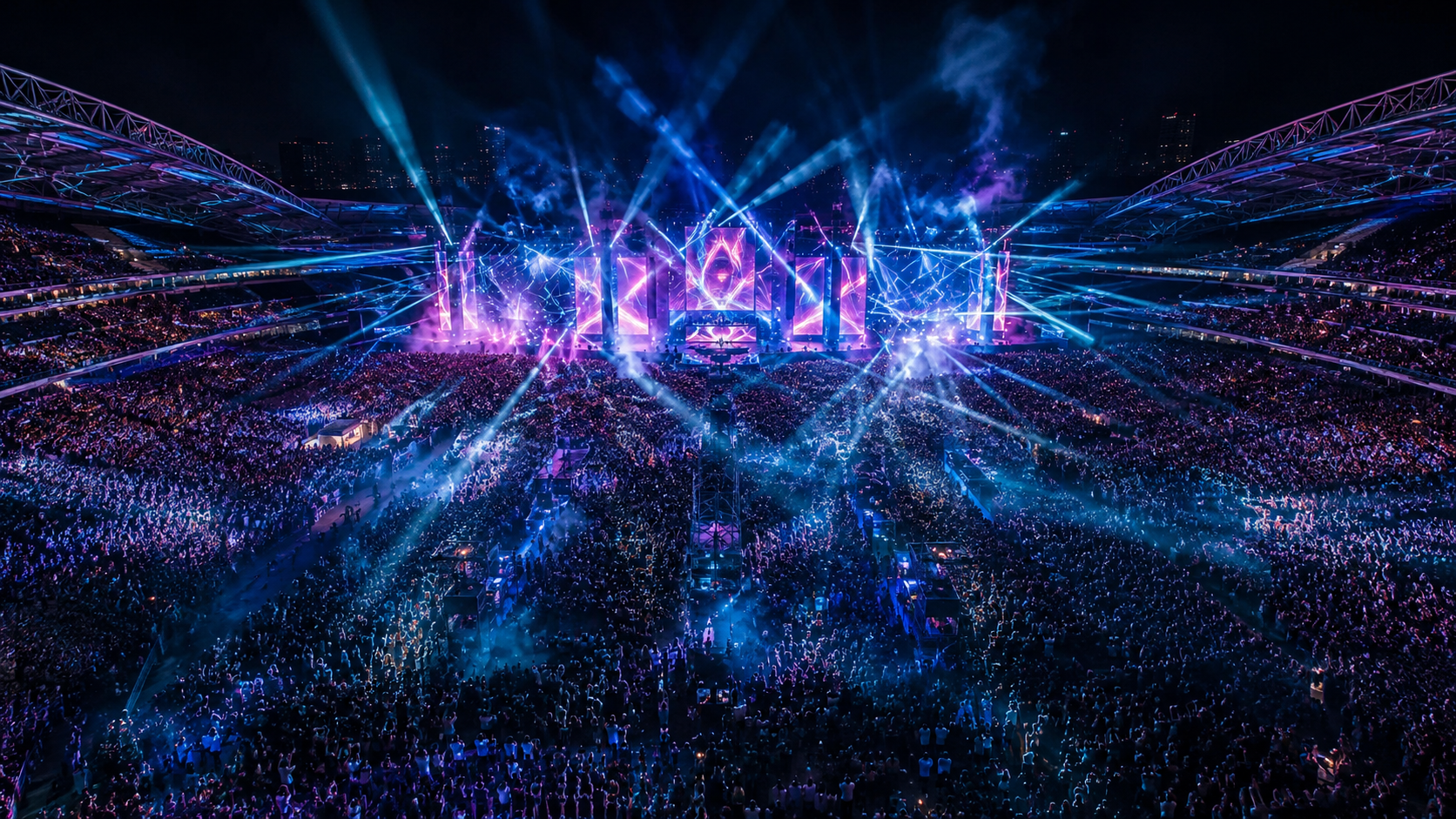

Dom Dolla’s rise from Melbourne club favourite to global electronic music phenomenon has culminated in sold-out stadium shows, more than 1.5 billion streams, and a level of cultural influence few Australian artists achieve. For the psychedelic medicine sector, however, the significance of his success may extend far beyond music. It may offer an important insight into how a generation increasingly values immersion, connection, experience, and community, themes that are becoming equally relevant inside clinics, research institutions, and the emerging psychedelic healthcare economy.
When tickets for Dom Dolla’s Marvel Stadium performances disappeared within hours, most commentary focused on the obvious story. Australia had produced another global music success. The Melbourne-based DJ and producer had completed a remarkable journey from club resident to international headline act, joining a small group of Australian electronic artists capable of attracting genuinely global audiences.
Yet beneath the streaming statistics, sold-out venues, and festival appearances lies a more interesting question. Why, in an age where virtually every piece of music ever recorded is available instantly through a smartphone, are tens of thousands of people still willing to spend hundreds of dollars and dedicate entire weekends to attending live events?
The answer cannot simply be the music itself.
Dom Dolla’s catalogue is available on demand. His performances can be viewed online. His tracks circulate endlessly across streaming platforms, social media feeds, and festival videos. If access to music were the primary consideration, there would be little reason for stadiums to fill. Yet they continue to do so, not only for Dom Dolla, but for a growing class of artists whose success is increasingly measured not by record sales but by their ability to create experiences people feel compelled to participate in.
For an industry focused on mental health, wellbeing, and human behaviour, that distinction is worth examining.
The psychedelic medicine sector has spent much of the past decade discussing molecules. Psilocybin, MDMA, ketamine, and other compounds have dominated headlines, investment presentations, and clinical discussions. Increasingly, however, researchers and practitioners are recognising that outcomes are influenced by far more than pharmacology alone. Concepts such as set, setting, preparation, integration, therapeutic alliance, environmental design, and connectedness have become central to contemporary discussions about treatment effectiveness.
At first glance, that world appears entirely unrelated to electronic music. One operates within healthcare. The other belongs to entertainment. Yet both industries have become intensely interested in the same fundamental question: how do environments shape human experience?
A modern electronic music event is, in many respects, an exercise in large-scale experience design. Every element is intentional. Sound systems are engineered to create a physical as well as auditory response. Visual production transforms venues into immersive environments. Lighting, pacing, anticipation, and crowd dynamics are orchestrated with extraordinary precision. The objective is not merely to play music. The objective is to create an emotional experience that participants remember long after the final track has ended.
That observation becomes particularly interesting when viewed through the lens of contemporary mental health research. Over the past decade, concerns about loneliness, social isolation, and declining community participation have become increasingly prominent. Despite living in the most technologically connected period in human history, many individuals report feeling disconnected from the people and communities around them. Psychologists, sociologists, and public health experts have all pointed to the growing gap between digital connectivity and genuine social connection.
Against this backdrop, the extraordinary popularity of immersive live events begins to look less like a music story and more like a cultural signal.
Researchers studying concerts, festivals, sporting events, and other large gatherings often refer to a concept known as collective effervescence, a term originally coined by sociologist Émile Durkheim. The concept describes the emotional energy generated when groups of people participate in a shared experience. Individuals report feeling connected to something larger than themselves, experiencing a temporary dissolution of social barriers and a heightened sense of belonging.
While the terminology may differ, some of the themes sound familiar to those working in psychedelic medicine. Connectedness, meaning, emotional openness, and social engagement have become increasingly important topics within psychedelic research. Not because a music festival and a therapy session are equivalent, but because both highlight the importance of human experience beyond purely individual processes.
The audience attending major electronic music events today is also different from the stereotypes often associated with dance culture. Walk through a contemporary festival or stadium event and you will find technology professionals, entrepreneurs, healthcare workers, academics, creatives, and increasingly, people who are deeply engaged in conversations about mental wellbeing. Many are part of a generation that places significant value on experiences over possessions, authenticity over status, and participation over passive consumption.
For investors and founders operating within the psychedelic sector, this demographic shift deserves attention. The same generation driving interest in psychedelic medicine is also helping reshape broader cultural expectations around wellbeing. They are accustomed to highly curated experiences. They value community. They expect environments to be thoughtfully designed. They increasingly view wellbeing as something that extends beyond symptom reduction and into questions of purpose, connection, performance, and quality of life.

In that sense, the Dom Dolla phenomenon may have less to do with electronic music than with a broader transformation occurring across society. People are not merely seeking entertainment. They are seeking experiences that feel meaningful, memorable, and socially significant. They are looking for moments that provide relief from the fragmentation of modern life and opportunities to engage with something larger than themselves.
For the psychedelic medicine industry, this observation carries implications that extend beyond culture. Clinics, healthcare providers, and emerging treatment models are increasingly competing not only on clinical outcomes but on patient experience. As the sector matures, organisations that understand how environment, community, and emotional engagement influence outcomes may ultimately prove more successful than those focused exclusively on pharmacology.
None of this suggests that a Dom Dolla concert should be viewed as a therapeutic intervention. Nor does it imply that entertainment and healthcare occupy the same category. The comparison is cultural rather than clinical. What makes it valuable is the insight it offers into changing human expectations.
Culture often identifies shifts before institutions do. Long before researchers publish papers, consumers change behaviours. Long before healthcare systems adapt, people begin seeking different kinds of experiences. Viewed through that lens, the extraordinary success of immersive music events may represent one of the clearest signals available about what future generations increasingly value: connection, participation, meaning, and experiences that feel genuinely transformative.
That may ultimately be the most important lesson the psychedelic medicine sector can take from the rise of Dom Dolla. Not that music and medicine are converging, but that both are responding to the same cultural reality. In an increasingly digital world, human beings continue to seek opportunities to gather, connect, and participate in experiences that remind them they are part of something larger than themselves.