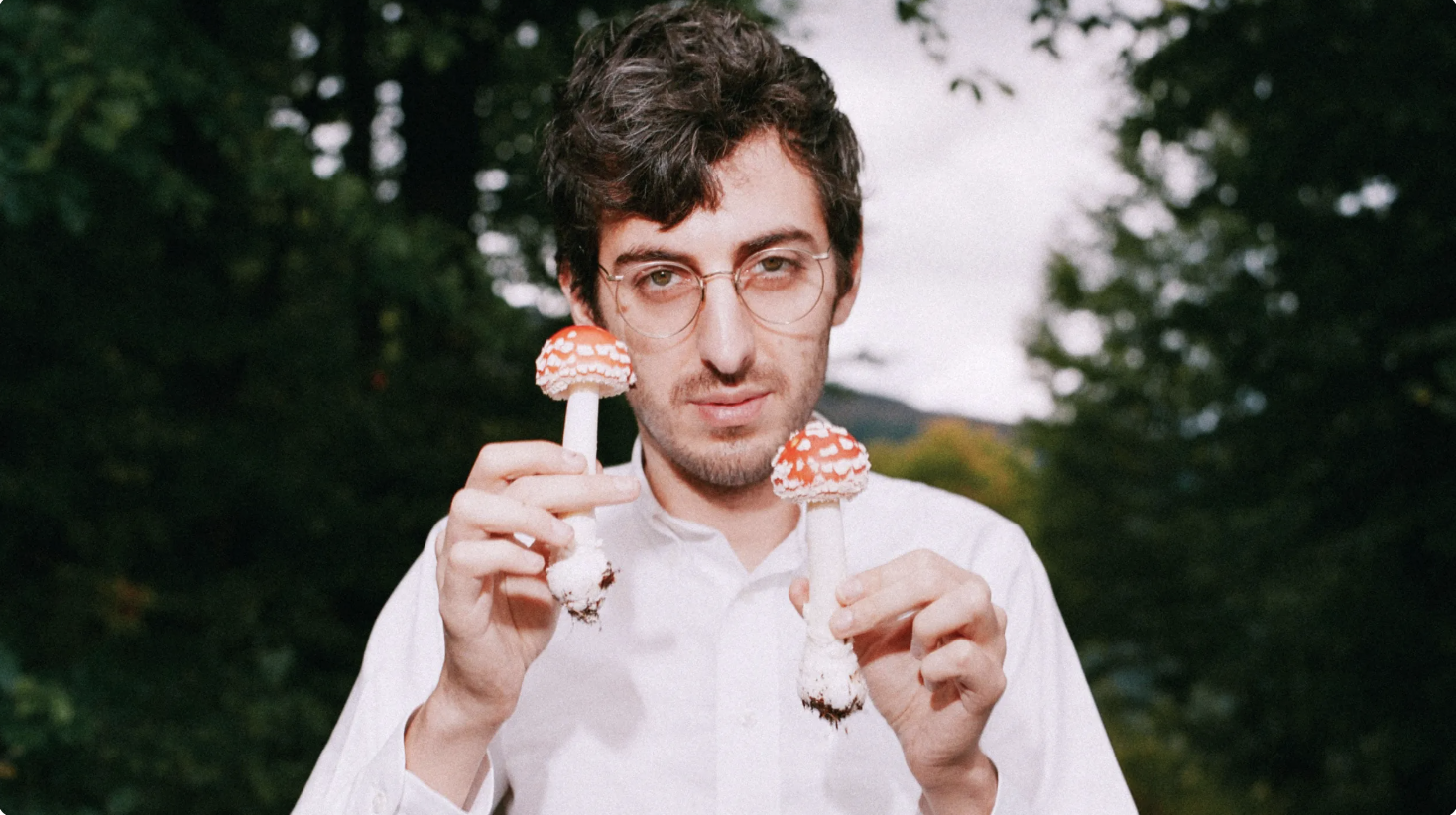

For more than a decade, Hamilton Morris has occupied a unique position in the world of psychedelic science. He is neither a biotech founder chasing venture capital nor a clinician leading groundbreaking trials. He is not an activist campaigning for legalisation, nor a traditional academic confined to a university laboratory.
Instead, Morris has become something arguably just as important: one of the world’s most trusted interpreters of psychedelic science.
Through meticulous journalism, documentary filmmaking and scientific research, he has helped transform public understanding of psychoactive compounds from sensational headlines into thoughtful discussions about chemistry, neuroscience, anthropology and medicine. At a time when psychedelic medicines are evolving from a fringe movement into a legitimate healthcare industry, Morris has become an influential voice, encouraging curiosity over ideology and evidence over hype.
A Different Kind of Science Communicator
Born in New York in 1987, Hamilton Morris developed an early fascination with chemistry and psychoactive substances. While many people approached drugs through politics, morality or personal experience, Morris was captivated by a much simpler question.
Why do these molecules produce such profound changes in human consciousness?
That curiosity led him into pharmacology, ethnobotany and medicinal chemistry, disciplines that would eventually shape both his journalism and his scientific career.
Unlike many science communicators, Morris has never sought to simplify complex topics into catchy headlines. Instead, he invites audiences into the complexity itself. Discussions about receptor binding, alkaloid biosynthesis and molecular synthesis become accessible because of his ability to explain difficult concepts without compromising scientific accuracy.
It is a skill that has earned him the respect of neuroscientists, chemists and pharmacologists while attracting an audience far beyond academia.
The Documentary That Changed the Conversation
Hamilton Morris became internationally recognised through Hamilton’s Pharmacopeia, a documentary series that began as an independent project before being commissioned by Vice Television.
Across multiple seasons, the series explored far more than psychedelic drugs. Rather than portraying psychoactive substances as either dangerous narcotics or miracle medicines, it examined the chemistry, history and cultural significance behind them.
Travelling across South America, Africa, Europe, Asia and North America, Morris investigated compounds ranging from psilocybin, LSD and DMT to obscure plant alkaloids, venom-derived molecules and synthetic research chemicals unfamiliar even to experienced researchers.
The programme quickly distinguished itself from conventional drug documentaries.
Instead of dramatic recreations or moralising narratives, viewers were introduced to organic chemists, indigenous healers, pharmacologists, clandestine chemists and neuroscientists. Each episode demonstrated that understanding psychoactive compounds requires far more than simply discussing their effects. It demands an appreciation of history, culture, biology and chemistry working together.
For many viewers, Hamilton’s Pharmacopeia became their first exposure to evidence-based discussions about psychedelic compounds.
Bridging Two Very Different Worlds
One of Morris’s greatest achievements has been his ability to bridge communities that have traditionally viewed each other with suspicion.
On one side sits academic science, where rigorous evidence, peer review and cautious interpretation remain paramount.
On the other lies psychedelic culture, a community often shaped by personal experience, spirituality and decades of prohibition.
Hamilton Morris speaks both languages fluently.

Researchers appreciate his technical understanding of pharmacology, while members of the psychedelic community recognise his respect for traditional knowledge and lived experience.
That rare combination has allowed him to become an effective translator between scientific institutions and the broader public.
More Than a Journalist
Although best known for his documentaries, Morris has also contributed directly to scientific research.
His work has included published research collaborations involving naturally occurring psychoactive compounds, medicinal chemistry and neuropharmacology, helping scientists better understand how psychedelic molecules interact with the human brain. He has also worked alongside researchers exploring compounds including 5-MeO-DMT and other naturally occurring psychedelics, reinforcing his reputation as more than simply a science communicator.
His interests extend well beyond classic psychedelics.
They include venom-derived medicines, naturally occurring alkaloids, dissociative anaesthetics, traditional ethnobotanical medicines and novel synthetic compounds. Rather than viewing drugs as isolated products, Morris approaches them as tools for understanding biology itself.
His work reflects a growing scientific consensus that studying psychoactive molecules may reveal entirely new insights into brain function, consciousness and psychiatric illness.
A Voice of Caution in a Rapidly Growing Sector
The psychedelic medicines sector has undergone remarkable transformation over the past decade.
Major pharmaceutical companies have entered the field. Venture capital has invested billions of dollars into psychedelic biotechnology companies. Governments, including Australia, have begun cautiously introducing regulated access to compounds such as psilocybin and MDMA for carefully selected patients.
Throughout this expansion, Morris has consistently warned against allowing commercial enthusiasm to outpace scientific evidence.
Unlike some advocates who portray psychedelics as universal solutions for mental illness, Morris frequently reminds audiences that these medicines remain experimental for many conditions.
Clinical outcomes vary significantly depending on diagnosis, therapeutic setting, patient selection, dosage, integration and psychological support.
While early trial results have been encouraging, he argues that responsible science requires acknowledging uncertainty as much as celebrating success.
That balanced perspective has occasionally placed him at odds with both enthusiastic investors eager for rapid commercialisation and campaigners pushing for broader legalisation. Yet it is precisely this willingness to challenge fashionable narratives that has strengthened his credibility.
Separating Evidence From Myth
Few scientific fields generate as much mythology as psychedelics.
Claims about ancient civilisations, secret government experiments, mystical experiences and revolutionary medical breakthroughs frequently dominate headlines.
Hamilton Morris has built much of his reputation by carefully separating verifiable evidence from speculation.
Whether discussing naturally occurring DMT in mammals, the history of LSD research or newly discovered psychoactive compounds, Morris consistently returns to primary scientific literature rather than repeating popular assumptions.
In doing so, he has demonstrated an important lesson for the emerging field of psychedelic medicine.
Good science is rarely sensational.
It progresses slowly through careful experimentation, rigorous methodology and an openness to being proven wrong.
Why Hamilton Morris Matters
Perhaps Morris’s most distinctive characteristic is intellectual humility.
Despite possessing an encyclopaedic knowledge of chemistry and pharmacology, he rarely presents himself as someone with all the answers. Instead, he openly discusses the limitations of existing research and frequently reminds audiences how little neuroscience still understands about consciousness itself.
In an era increasingly dominated by social media certainty, Morris has demonstrated that admitting uncertainty can be a sign of expertise rather than weakness.
His influence now extends well beyond television audiences. Across universities, biotechnology companies and research institutes, many younger scientists credit his work with inspiring their interest in medicinal chemistry, pharmacology and neuroscience.
Rather than romanticising drug use, his documentaries encourage viewers to ask scientific questions.
How are these molecules synthesised?
How do they bind to receptors?
What evolutionary purpose might they serve?
Can they be developed into safer medicines?
Those questions continue to shape a new generation of researchers entering the field.
The Road Ahead
As psychedelic medicine enters a new era of regulation, commercialisation and clinical adoption, trusted communicators capable of explaining complex science without exaggeration will become increasingly important.
Researchers will continue refining treatment protocols. Regulators will assess expanding evidence. Investors will pursue commercially viable therapies. Patients will seek safe and effective treatments grounded in robust science.
Hamilton Morris has spent more than a decade demonstrating that credibility is earned not through advocacy or certainty, but through curiosity, intellectual honesty and rigorous investigation.
In an industry often defined by bold predictions and ambitious promises, his career serves as a reminder that the most meaningful discoveries rarely begin with certainty—they begin with asking better questions.