
Now part of Rhelion Life Sciences, Canadian pharmaceutical developer Filament Health is supplying naturally derived psilocybin for clinical research worldwide, including a new study investigating social anxiety disorder in Sweden.
Canadian pharmaceutical developer Filament Health is expanding its international research partnerships as interest grows in naturally derived psychedelic medicines.
Now operating as a subsidiary of Rhelion Life Sciences, formerly Red Light Holland, the company specialises in extracting, purifying and manufacturing psychedelic compounds from natural sources to pharmaceutical standards.
Its lead product, PEX010, is a standardised botanical psilocybin formulation currently supporting more than 80 academic and philanthropic research studies worldwide, according to the company.
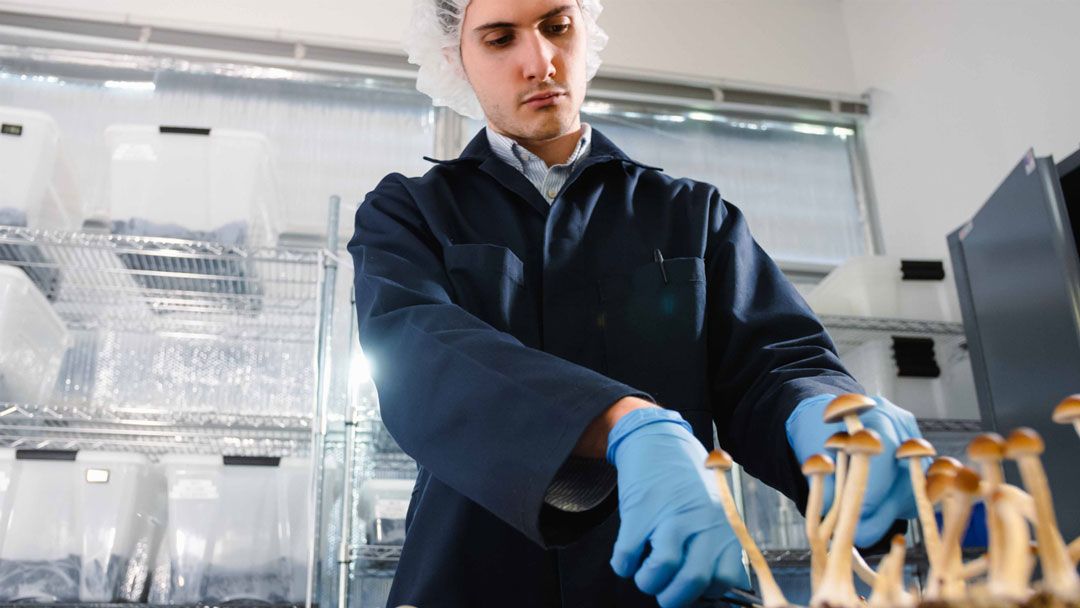
Unlike manufacturers producing psilocybin through chemical synthesis, Filament has developed processes for obtaining the compound directly from psychedelic mushrooms while maintaining the consistency and quality required for clinical investigation.
The approach has attracted partnerships with universities and research institutions investigating psilocybin for psychiatric, neurological and substance-use disorders.
New Swedish Trial to Investigate Social Anxiety Disorder
On 28 October 2026, Rhelion announced that Filament had signed a supply and licensing agreement with Linköping University in Sweden for a clinical trial investigating psilocybin as a potential treatment for social anxiety disorder.
The study, known as PsiloSAD, will be led by Professor Markus Heilig and will use Filament’s PEX010 formulation.
Linköping University will sponsor and conduct the trial, with Filament responsible for supplying the investigational medicine under the agreement.
The study is registered under EU clinical trial identifier 2026-526267-37-00, although its commencement and the supply of PEX010 remain subject to the necessary regulatory and ethics approvals.
Social anxiety disorder can significantly affect everyday functioning, including employment, relationships and social participation. While established psychological and pharmaceutical treatments are available, some patients continue to experience substantial symptoms.
The trial will investigate whether psilocybin could offer another treatment approach, although its effectiveness for this indication remains to be established.
Developing Pharmaceutical Medicines from Natural Sources
Filament’s manufacturing process begins with naturally occurring psychedelic compounds found in fungi and plants.
Through cultivation, extraction, purification and analytical testing, the company produces standardised formulations intended for regulated pharmaceutical research.
This presents a different manufacturing approach from that of developers using synthetic psilocybin, although the active psilocybin molecule is chemically identical regardless of its origin.
For pharmaceutical manufacturers, the challenge with botanical materials is consistency. The chemical composition of mushrooms can vary according to genetics, growing conditions and processing methods.
Filament’s technology is designed to manage this variability and produce formulations with defined chemical specifications and reproducible doses.
The company also holds a Health Canada Controlled Substances Dealer’s Licence, authorising specified activities involving controlled substances.
Its lead formulation, PEX010, is available in standardised doses of 1 mg, 5 mg and 25 mg, with a 0.5 mg presentation also planned.
Although botanical formulations may contain additional naturally occurring constituents, there is currently insufficient evidence to conclude that naturally derived psilocybin provides better clinical outcomes than its synthetic equivalent.
For Filament, the immediate commercial opportunity lies in manufacturing pharmaceutical-grade material that can be supplied consistently across clinical research programmes.
Research Partnerships Across Multiple Conditions
PEX010 has been supplied for research associated with institutions including Johns Hopkins University, Imperial College London, the University of California, San Francisco and the University of Oxford.
Recent agreements and research shipments have extended the company’s involvement into several additional areas.

At the University of California, San Francisco, researchers are investigating psilocybin for methamphetamine use disorder among people living with HIV.
In Canada, the University of Calgary is conducting a phase 2 study examining psilocybin-assisted therapy for post-traumatic stress disorder (PTSD) in survivors of intimate partner violence.
Australian researchers are also involved. The University of Melbourne is investigating psilocybin-assisted physiotherapy for functional neurological disorder, a condition affecting nervous system functioning.
Filament has additionally established research supply relationships in Europe, including programmes in Italy, Germany and Belgium.
These activities place PEX010 in a growing range of clinical research settings, although individual programmes are at different stages and their outcomes cannot be assumed.
Filament primarily acts as a pharmaceutical supplier in these arrangements, rather than conducting the trials itself.
Beyond Psilocybin
While PEX010 remains Filament’s principal pharmaceutical programme, the company has also investigated other naturally derived psychedelic compounds, including DMT, harmaline, mescaline and ibogaine.
Its ibogaine candidate, IBEX011, is being developed through the company’s botanical extraction platform.
Ibogaine has attracted research interest for potential applications in substance-use disorders, although serious cardiac safety risks remain a significant concern.
The programme is at an earlier stage than PEX010 and has yet to establish a comparable clinical research supply network.
Filament’s broader work reflects an interest in developing pharmaceutical formulations from several naturally occurring psychedelic substances rather than concentrating exclusively on psilocybin.
Acquisition by Rhelion Life Sciences
Filament became a wholly owned subsidiary of Red Light Holland following completion of its acquisition on 30 April 2026.
The parent company subsequently adopted the name Rhelion Life Sciences, bringing Filament’s pharmaceutical manufacturing capabilities and intellectual property into its wider business.
As of the October announcement, Filament’s intellectual property portfolio included 78 issued patents across 13 patent families.
The acquisition also provided Rhelion with an established pharmaceutical research supply business and an investigational psilocybin product already being used by researchers internationally.
For the enlarged company, pharmaceutical manufacturing and institutional supply agreements now form an important part of its development strategy.
What Comes Next?
Filament’s growing network of research partnerships provides opportunities for its botanical psilocybin formulation to be evaluated across different clinical indications.
The latest agreement with Linköping University adds social anxiety disorder to that research activity, alongside existing studies investigating depression, PTSD, substance-use disorders and neurological conditions.
However, the number of studies using a formulation is not itself evidence of clinical effectiveness.
PEX010 remains an investigational medicine, and further research will be needed to establish its safety and efficacy for specific conditions before any broader regulatory approvals can be considered.
For Filament and Rhelion, the more immediate focus is on supplying pharmaceutical-grade material to research institutions, expanding manufacturing capabilities and supporting the clinical investigation of naturally derived psychedelic medicines.
Sources: Rhelion Life Sciences announcement, 28 October 2026 and Rhelion Life Sciences.